
Talks
Experience a mind-changing talk from an award-winning lecturer and expert on how present, past and future interplay in shaping your life, identity and thoughts.
All talks can be offered in English, Norwegian, and Greek.

In his talks, Apostolos invites audiences to step back and view the world through a wider lens. He explores subjects related to how the past dictates the present and future of individuals and organizations, based on his long-time research and teaching in subjects like innovation, path dependence and what he calls “laziness”, that is the natural law of least possible consumption of energy.
He also explores humankind and each individual as history-made and history-making, that is as shaped by our past and having the agency of changing the present and future. When addressing the “invisible gravity” of individual and organizational inertia and path dependence, his goal is to spark a conversation about how we can stop simply following premade paths and start performing in creative and innovative ways.
All talks can be delivered in English, Norwegian and Greek.
-
Why do organizations fail?
Guides on how to innovate and lead abound, yet companies collapse every day. The problem isn’t a lack of fresh ideas; it is that organizations are trapped by the comfortable gravity of their own history. Blind to how their past dictates their present, they stagnate.
This lecture breaks that gravity. Across three sessions, we will explore:
The Power of Yesterday: Uncovering how your organization's history quietly shapes—and constraints—your future.
The Art of Exnovation: Learning the deliberate, strategic dismantling of outdated but fiercely cherished ideas, practices, and systems.
Breaking Path Dependence: Identifying and escaping the trap of harmful routines that persist simply because "that's the way we've always done it."
This lecture will help you stop managing the past, fight against your path dependences, and start designing the future.
-
Why do universities struggle to transform?
Contemporary higher education is saturated with frameworks for innovation and reform, yet universities across the globe often exhibit limited capacity for meaningful transformation. The challenge is not a scarcity of novel ideas, but rather the enduring influence of institutional legacies. Universities remain embedded in historically sedimented structures that shape, and at times constrain, present practices and future trajectories. Insufficient reflexivity regarding these temporal dynamics results in the reproduction of the status quo.
This lecture addresses the problem of institutional and personal persistence in academia. Across three sessions, we will examine:
Institutional Legacy and Academic Continuity: How historically embedded norms, disciplinary configurations, and organizational routines quietly delimit the scope of possible change within universities.
Strategic Exnovation: The systematic and intentional discontinuation of obsolete programmes, administrative arrangements, and entrenched practices that no longer serve contemporary academic or societal needs.
Beyond Path Dependence: Identifying and disrupting self-reinforcing institutional patterns (such as inherited evaluation metrics, pedagogical models, and administrative norms) that persist primarily due to their historical entrenchment rather than their present utility.
Institutional heritage need not function as a constraint on renewal. The lecture proposes ways of critical engaging with what must be discontinued, which can help universities reach an administrative and academic transformation that is deeply needed in the era of AI.
-
We like to think that we are free, that we can think and do whatever we want, that we decide our own lives. But is that true? Or are we little more than marionettes dancing a choreography designed decades, centuries or millennia ago?
The choreography is nice (often, not always), but do we dance it because we like it or because we follow what is expected to be “right”? And who has decided what is “right”? And when?
We are created by history, both as biological machines and as socio-cultural animals. Even the myth of our “soul” is a historical creation. And we have nice names to talk about the threads that lead us in history’s choreography: culture, traditions, habits and values are some of them.
The lecture is an invitation to think about all of us, individually and collectively, as marionettes created by history. Let us try to understand ourselves better by looking into the mirror of history — and let us hope that we will not get frightened by what se see in it.
-
Why are we still treating AI as an enemy or a shortcut?
Higher education debates on AI are too focused on AI-driven cheating and generic policies on restriction. Yet, the real challenge isn’t preventing students from using AI; it’s that universities are struggling to weaponize it pedagogically. By failing to integrate AI into how we can teach creatively and think critically on how to make assessments a part of the learning process, we risk preparing students for a world that no longer exists.
This lecture moves past the abstract debates and panic. Grounded in verified classroom success, it explores a blueprint for responsible, human-in-the-loop AI integration. Over three sessions, we will discover:
Pedagogy-First Co-Creation: Shifting AI from a basic text-generator to an active, creative partner in the classroom, based on custom AI-assisted teaching methods built for student engagement.
Rethinking Assessment: Moving away from static exams toward dynamic, AI-assisted assessment models that measure deep critical thinking—proven to yield highly positive results in live student pilots.
The BloomingAI Framework: An exclusive look inside the international EU project (bloomingai.eu), revealing how we are building open-source learning platforms structurally aligned with Bloom’s taxonomy.
Let us stop banning the future and start engineering it in an ethical, critical and creative way.
-
How can you help your students to think critically in a playful way?
Static lesson plans give answers; traditional educational games give fixed, predictable paths. Neither easily serves deep thinking and student active learning. For educators across all disciplines, the challenge isn't just finding engaging tools; it is rather navigating the fine line between shallow digital entertainment and rigorous, curriculum-driven learning.
This lecture offers a classroom-tested method of AI-powered, game-based learning. Built on firsthand experience designing and deploying an AI-assisted game originally engineered around my course on historical consciousness, this lecture showcases how intelligent game design can revolutionize your classroom.
Designed for university, college, and secondary school teachers of all subjects, this session will explore:
The Blueprint of an AI-Assisted Game: An inside look at the mechanics of a game based on the use of free GenAI, demonstrating how any chatbot can be a playful assistant of critical thinking and student-active learning.
From Play to Pedagogy: Practical, actionable strategies for integrating AI-driven gaming into your specific curriculum without sacrificing academic rigor.
Navigating the Sandbox: A candid breakdown of the real-world challenges—from managing unpredictable AI outputs to effectively assessing student learning inside an open-ended, playful environment.
Let me help you stop teaching subjects as static facts. and turn your class into a game environment, in which your students will enjoy learning.
Get to know your instructor
Apostolos Spanos is professor of History at the University of Agder, Norway. His research and teaching are based on interdisciplinary approaches to history as a discipline and to historical evolution as a phenomenon. His interests lie in applied history, historical consciousness, the multi-dimensionality of historical time, the coinherence of present, past and future, modeling history, the use of AI in studying and teaching history, the use of games to study the past, and the study of innovation as a mode of historical existence and evolution.
He has led doctoral seminars on path dependence and innovation, and has given courses on a range of subjects, including historical consciousness, the use of history in political and sociocultural terms, and games and gaming as historical sources. He has used various methods and strategies of teaching, including video-based and game-based flipped classroom and the use of AI to improve student performance in classrooms and the exams.
In 2025 he was awarded the University of Agder's Education Award "as an innovative and engaging teacher, who has contributed to developing teaching methods, assessment methods and subjects that have had significance both nationally and internationally".
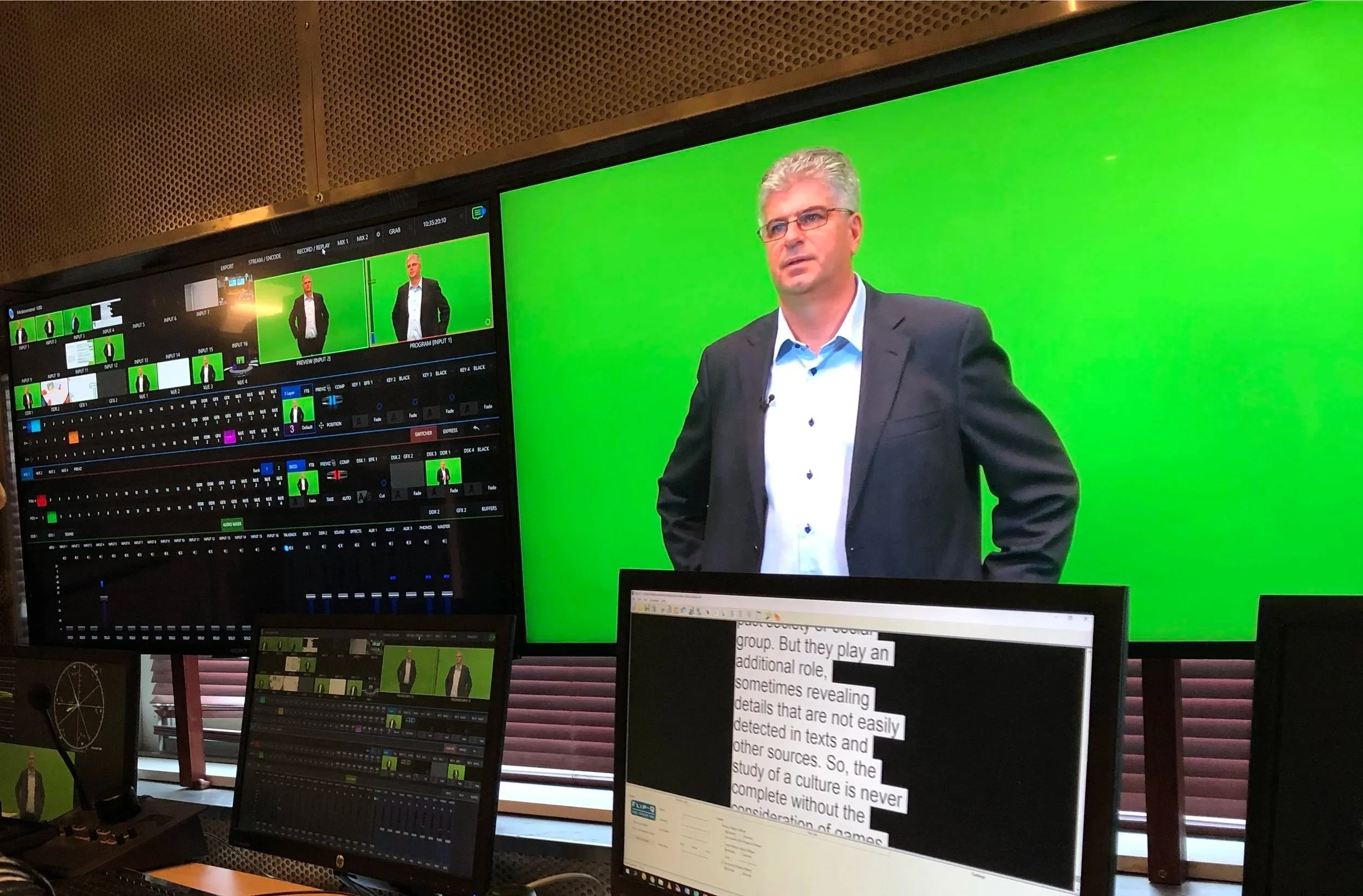
Just a click away …
If you're interested in a talk by Apostolos, complete the form with a few details about your needs. We will review your message and get back to you within 48 hours.